No postcode left behind: building virtual care around communities, not the other way around

Panel recap from the National Rural and Remote Healthcare Conference 2026, co-located with the National Indigenous Healthcare Forum, Sydney
FEATURED SPEAKERS
Lindsay Moore – Head of Operations at Consultmed
Ben Chiarella – Registered Nurse and Director of Clinical Innovation at Visionflex
Abe Warwick – Director of Customer Success at Visionflex (Moderator)
At the National Rural and Remote Healthcare Conference in Sydney, co-located with the National Indigenous Healthcare Forum, the loudest idea in the room was not a new piece of hardware or a platform demo. It was about people. The virtual care technology is available and it works. But what makes it work for remote and rural communities are models of care built around the people already there.
That was the throughline of “No Postcode Left Behind: Advancing Virtual Care for Rural and Remote Communities,” a panel session co-sponsored by Australian health technology companies Visionflex and Consultmed.
Moderated by Abe Warwick, Visionflex’s Director of Customer Success, the session brought together an expert panel featuring Lindsay Moore, Head of Operations at Consultmed, and Ben Chiarella, Registered Nurse and Director of Clinical Innovation at Visionflex.
Warwick opened with the problem he says he sees daily. “We don’t have a shortage in this country of virtual care technology,” he said. “We’ve got a shortage of virtual care that’s actually still being used daily, six months later after being deployed.”
That framing set up twenty minutes on workflow mechanics to workforce economics and, ultimately, the case for building models of care around communities.
From referral to conversation
Moore used a familiar scenario to describe Consultmed’s Advice and Guidance model: a GP in a rural town with a diabetic patient whose management plan is not working, an endocrinologist an hour away who visits once every two months, and a hospital three hours further still. Under a standard referral pathway, that patient faces months of waiting, travel and cost before getting an answer that might have been straightforward.
Advice and Guidance changes the sequence. “A GP can request guided specific advice from a specialist” directly through the Consultmed platform, attaching pathology and imaging, Moore explained. “The response comes back in a much shorter time, say perhaps two to three days, rather than the patient having to wait three months.”
The results back the model up. Moore pointed to Queensland’s Mater eConsultant service, live on the Consultmed platform since September 2025, which has supported more than 250 GPs and primary care practitioners sending over 1,000 requests for advice and guidance.
Of those, “almost 92% of those patients avoided the need for a face-to-face outpatient appointment,” and 66% of cases led to “a meaningful change to the patient’s management plan.” Requests were turned around in 1.7 days on average, against a three-day KPI target.
Thirty thousand referrals, one organisation
A case study was put to the room where a Consultmed customer moved from fax and paper-based referrals to a fully digital model built with Consultmed, processing roughly 30,000 referrals in the past year.
The practical upside was not just speed. It was preparation.
“If we can get the GPs engaged to actually commence that process earlier, it means that that patient maybe only needs to come for one appointment,” it was said, describing how two-way communication through the platform lets specialists request diagnostic testing before a patient arrives. In services where subspecialty appointments are scarce, that single change compounds.
“Those appointments… are so precious, and we want to make sure that every appointment is being used meaningfully.”
The workforce is the real constraint
If Moore made the case for digital referral infrastructure, Chiarella made the case for treating workforce, not technology, as the actual design problem.
Australia is short roughly 3,600 GPs today, a gap he said is projected to reach 12,000 within a decade. The nursing shortfall is expected to grow from around 30,000 to 80,000 by 2035. Training more rural clinicians helps, but “we’re still not going to meet the demand,” he said. The more urgent question, in Chiarella’s view, is how to use the workforce already in the system more efficiently, including metropolitan clinicians who could contribute remotely.
“I spoke to a clinician only about three weeks ago,” Chiarella said. “He lives in Sydney. He said, ‘I would love to give a day a week to rural communities virtually.’ But he’s just not able, at the moment, to do that.” He cited a Swinburne University study that found flexibility, not pay, is what clinicians want most from their work.
That is the logic behind hub-and-spoke virtual models: local clinicians handle presence and continuity, remote specialists handle volume and reach, and nobody spends “sixteen hours” of a specialist’s week flying to and from a single town when that time could support “another half a dozen towns and communities” virtually.
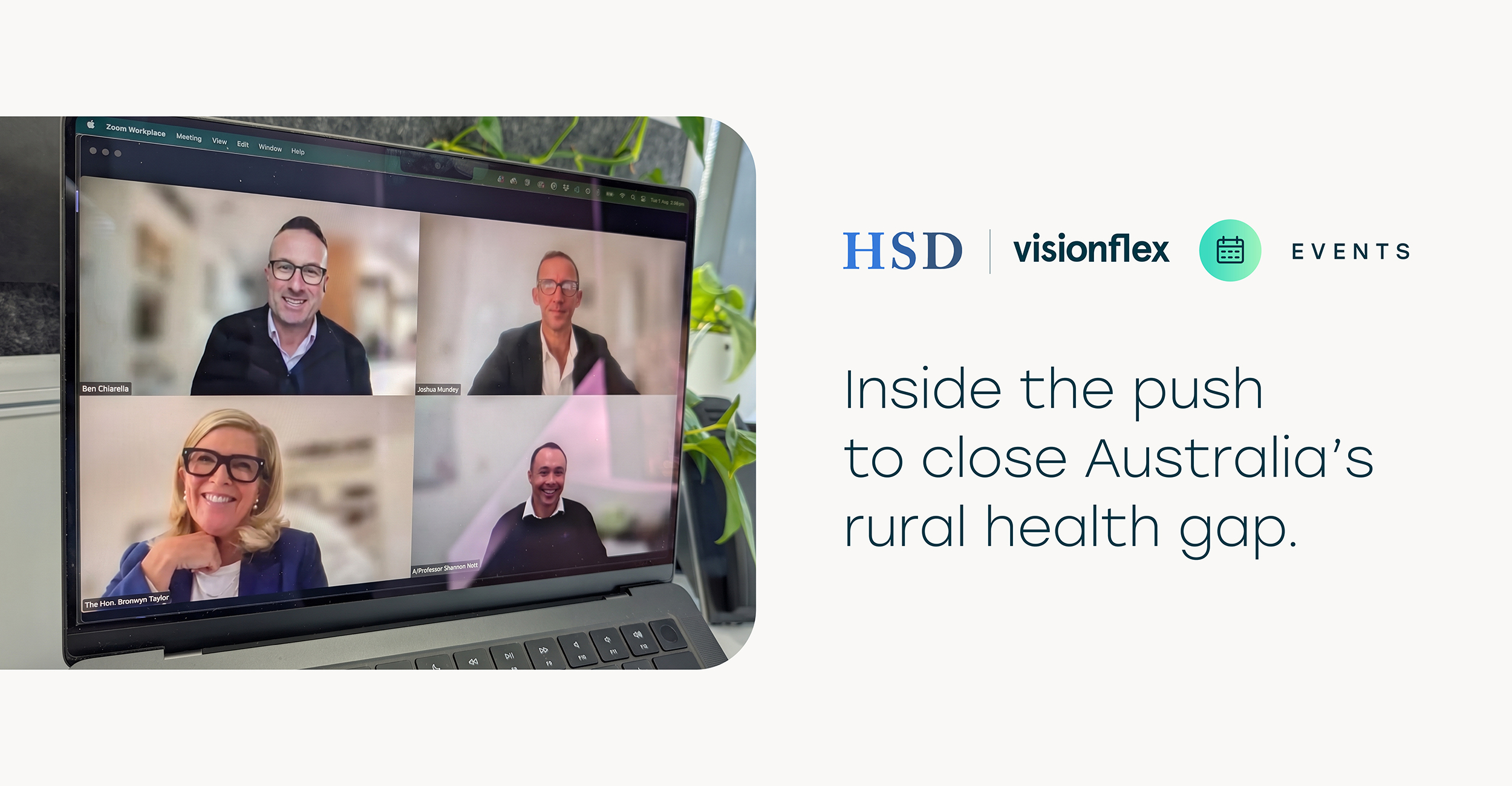
Warwick pointed to Derby, in Western Australia’s Kimberley region, as a working example of that shift. The service went from a walk-in clinic doing “a little bit of telehealth” to running roughly eight hours of virtual care a week, with two GPs linking in from Perth on Visionflex’s platform while the local workforce handles everything coming through the door.
Technology second, community first
The panel’s sharpest moment came when Chiarella described killing a sales deal. A prospective customer wanted virtual care technology but could not say what problem it would solve. “The worst thing we can do is sell tech when there’s no model of care,” he said.
He pointed to a well-intentioned national policy that equipped 25% of Australia’s aged care homes with technology after the Royal Commission, without a model of care attached. Much of it, he said, “is just sitting there being wasted,” not because the technology failed but because nobody built the clinical workflow around it before the hardware arrived.
The fix, in Chiarella’s telling, starts local.
Citing Dr Shannon Nott, his former colleague with whom he helped establish Australia’s first Virtual Rural Generalist Service, now working with the Royal Flying Doctor Service (South Eastern Section), he offered a line that stuck with the room: “When you’ve seen one rural town, you’ve seen one rural town.”
Every community has a different clinical baseline, workforce and relationship to outside services, and a virtual model that ignores that context is a technology deployment, not a model of care.
That principle is written into the Virtual Rural Generalist Service model itself. Clinicians, working through the platform Chiarella helped build, spend ten days in one of their partner communities every six months, a contractual commitment designed to keep remote specialists grounded in the towns they serve rather than purely screen-based.
Returning to the Consultmed customer case study, advice for other health leaders echoed the same instinct at a service level: start small. The most successful digital transformations begin with a narrow, well-executed slice of the referral process rather than a system-wide overhaul.
Two platforms, one gap
The partnership behind the session reflects the same division of labour the panel described on stage. Consultmed’s Advice and Guidance model solves for asynchronous specialist input, letting a GP get a considered answer without a referral or a wait. Visionflex’s virtual care platform and supporting hardware solve for the moments when clinical insight is needed more immediately, connecting remote generalists and specialists into a consultation as it happens.
Neither company pitched the other’s product from the stage. What they shared instead was a common conclusion: rural and remote health access improves when digital infrastructure is built around existing clinical relationships, not instead of them.
Asked to close with one sentence each, the panel’s answers landed on the same point from three directions.
Lindsay Moore: “Let’s build around the clinicians that are already in rural communities and fund specialist advice, as the important clinical work that it actually is, and stop treating a postcode like a clinical criterion.”
Ben Chiarella: “We need to start creating workforce and work around people, and that’s where virtual care comes in.”
For an industry that spends a lot of energy talking about platforms, it was a useful reset. The technology is rarely the hard part. What sticks, six months after deployment, is whatever was built around the people using it.
About the sponsors

Consultmed is an Australian health technology company that provides a comprehensive suite of digital solutions for e-Referrals, virtual triage, consent, and digital Advice & Guidance.
Driven by clinicians, Consultmed’s enterprise-grade software streamlines administrative tasks, enhances communication among healthcare providers and optimises the patient pathway for a more efficient and connected healthcare experience. These capabilities are complemented by Consultpilot AI – Consultmed’s intelligent AI-powered assistant designed to simplify document handling and automate paper workflows.

Visionflex is an Australian clinical virtual care platform, built on purpose-designed software and supporting hardware for remote consultations, diagnostics and workforce models in rural, remote and aged care settings.